Practice may teach the brain a new movement, but what happens immediately afterward could determine whether that skill lasts.
Scientists have long known that repetition alone does not guarantee learning. A newly practiced movement must be stabilized through memory consolidation, a process that continues after training ends. New research in mice suggests that signals arriving from the body can help create the conditions needed for that transformation.
Researchers at Tohoku University who specialize in super-network brain physiology found that stimulating the vagus nerve after training produced stronger motor learning over the following days. The results reveal a potentially important role for communication between the internal organs and the brain in shaping long-term learning.
The findings were published in iScience.
A Nerve Linking Body and Brain
The vagus nerve is one of the body’s most important communication pathways. It carries sensory information from internal organs to the brain while also transmitting commands from the brain that help regulate functions such as heart rate and digestion.
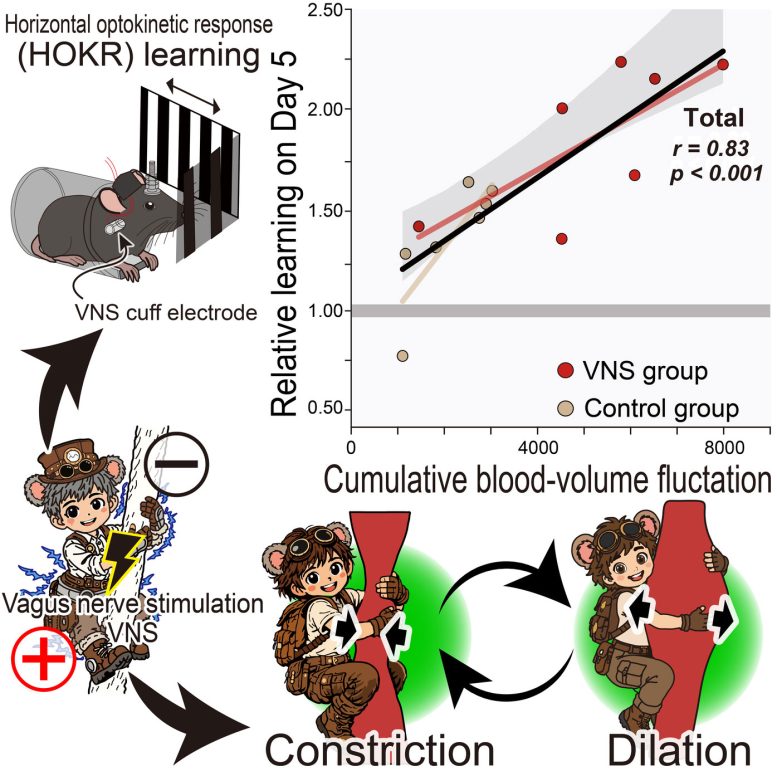
Vagus nerve stimulation (VNS) is already approved to treat several disorders. Scientists have generally studied it as a way to influence neurotransmitters and alter activity across neural networks. The new research points to another possible mechanism: changes in the tiny blood vessels that help supply active brain tissue with oxygen and nutrients.
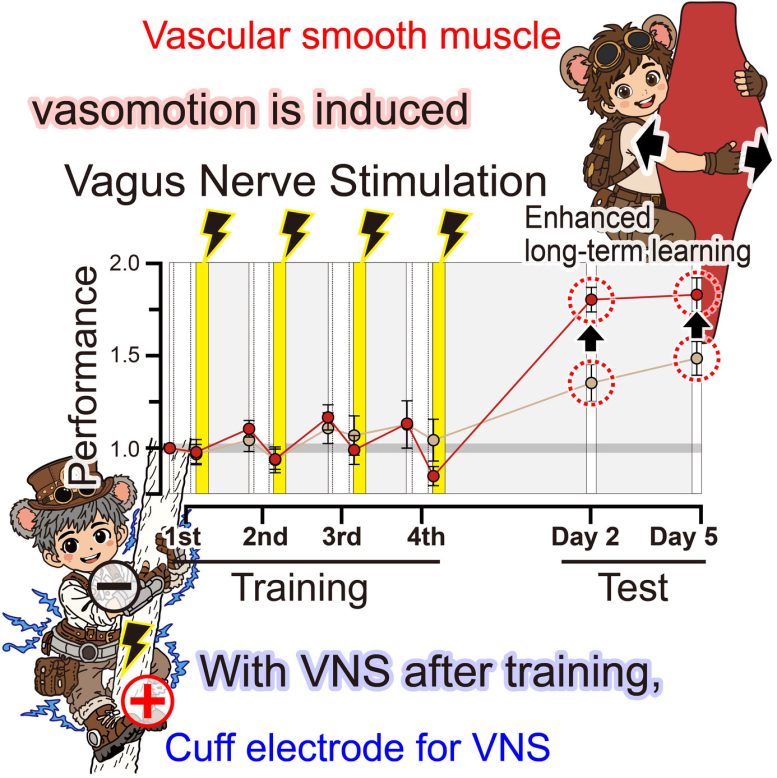
To investigate, the team designed a small cuff electrode that could remain secured around the left cervical vagus nerve of a mouse. The researchers then tested stimulation during horizontal optokinetic response (HOKR) learning, a task that depends on the cerebellum, the brain region central to movement timing, precision, and adaptation.
Learning Continued After Practice
During the task, mice learned to follow moving visual stripes more effectively with their eyes. The response resembles the automatic eye movements a person makes while standing on a platform and watching the cars of a passing train.
Crucially, the researchers delivered VNS only after each training session. It offered no immediate performance boost while the mice practiced. Instead, the advantage appeared on later days, when stimulated animals retained stronger learning. This delayed benefit indicates that VNS acted on the processes that preserve a motor memory after practice rather than helping the animals perform the task in the moment.
“The key point is that VNS was delivered only after training,” says Professor Ko Matsui. “Our findings suggest that VNS may open a hidden window of opportunity for enhanced learning by making the brain environment more receptive to long-lasting change.”
Rhythmic Blood Flow Tied to Memory
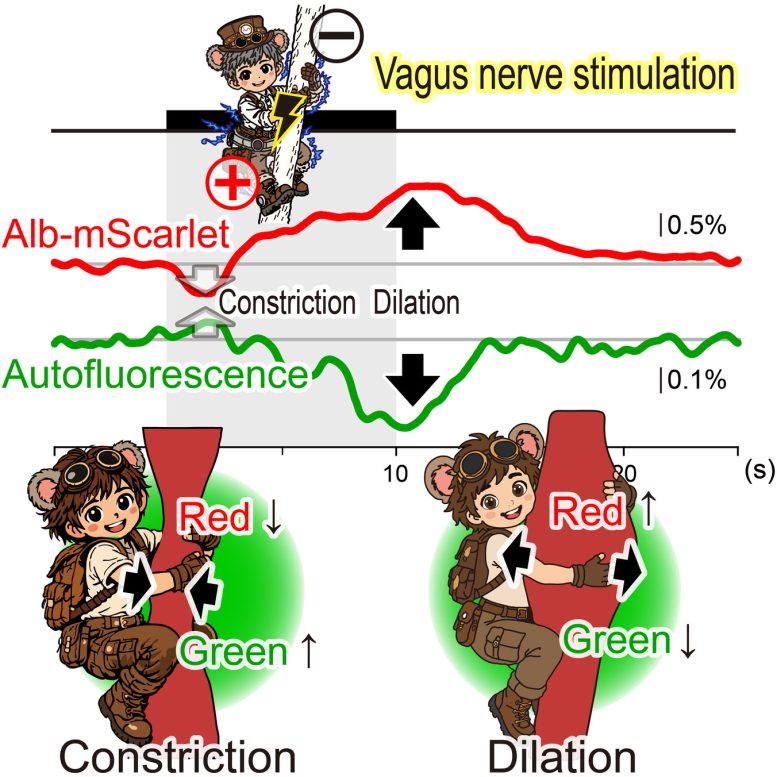
The team searched for physical changes that might explain the effect by measuring blood volume near the cerebellar flocculus, an area involved in HOKR learning. Using fiber photometry, the researchers found that one train of VNS produced a two-stage vascular response. Blood volume briefly declined before increasing after a delay.
Repeated stimulation generated rhythmic oscillations in local blood volume. The size of these fluctuations also appeared to matter: mice with larger oscillations tended to demonstrate stronger learning on Day 5. The association suggests that VNS may help consolidation partly by reshaping the metabolic environment around the brain circuits altered during training.
“Our brains may be more strongly influenced by the body than we imagine,” says lead author Junyu Chen. “By tuning the brain’s metabolic environment, including rhythmic vascular movements, we may eventually unlock capacities that would otherwise remain latent.”
A New Window for Motor Learning
The work was conducted in mice, so it does not yet show that stimulation after practice would improve human learning. It does, however, shift attention toward a period that is easy to overlook. A training session may end when practice stops, but the biological work of preserving that experience continues.
Future studies will refine the timing and pattern of stimulation while examining how vascular rhythms contribute to long-term plasticity. Understanding this two-way communication between the brain and body could eventually reveal why some experiences become durable skills while others fade and whether the brain’s post-training window can be used to make learning more effective.
Reference: “Vagal nerve stimulation induces vascular oscillations and enhances long-term learning” by Junyu U. Chen, Yoko Ikoma and Ko Matsui, 25 August 2026, iScience.
DOI: 10.1016/j.isci.2026.117413
Never miss a breakthrough: Join the SciTechDaily newsletter.
Follow us on Google and Google News.